A Linn County Farmer Built a Wetland Next to a Busy Road. That was the Point.
posted
by Kean Roberts on Friday, August 7, 2026
Three hay racks were needed to take 50 participants — farmers, watershed coordinators, and nonprofit members — to the wetland at the edge of Jim O'Connell's farm. Before departing, Vanya North, the Habitat Education Coordinator for Practical Farmers of Iowa, offered bottled water and reminders of protection from the summer sun. The field day, "Cleaning Water with Edge of Field Practices for Watersheds and Wildlife" was hosted by Practical Farmers of Iowa and cosponsored by the Iowa Environmental Council. The wetland sits next to a busy road. "I thought it was a great spot for it," Jim O'Connell later told me. "People would drive on by and see it." A practice nobody sees is a practice nobody copies.
.JPG)
O'Connell started farming outside Cedar Rapids with his dad in 1988 and took over the farm in 2004. He coaches football at the local high school, and he talks like someone who is used to explaining why the more disciplined approach is the more responsible path. "One word drives me as a person," he told the group in his machine shed. "Accountability. Be accountable for what you're doing."
In addition to installing the wetland, O'Connell has planted cover crops for the past 17 seasons — trying enough application methods to have opinions about them all. He has also installed a saturated buffer and a bioreactor. This wetland is the newest piece of a system he has assembled over two decades. His own testing has revealed that water enters the wetland with a nitrate-nitrogen concentration of 8 mg/L and leaves at 3-4 mg/L. The federal drinking water standard is 10 mg/L, but IEC's Environmental Risk Factors and Iowa’s Cancer Crisis report documented cancer associations at concentrations below that — some as low as 2 mg/L over long exposure periods. That’s why on-farm nitrate reduction practices like O’Connell’s are critical in reducing exposure for all Iowans.
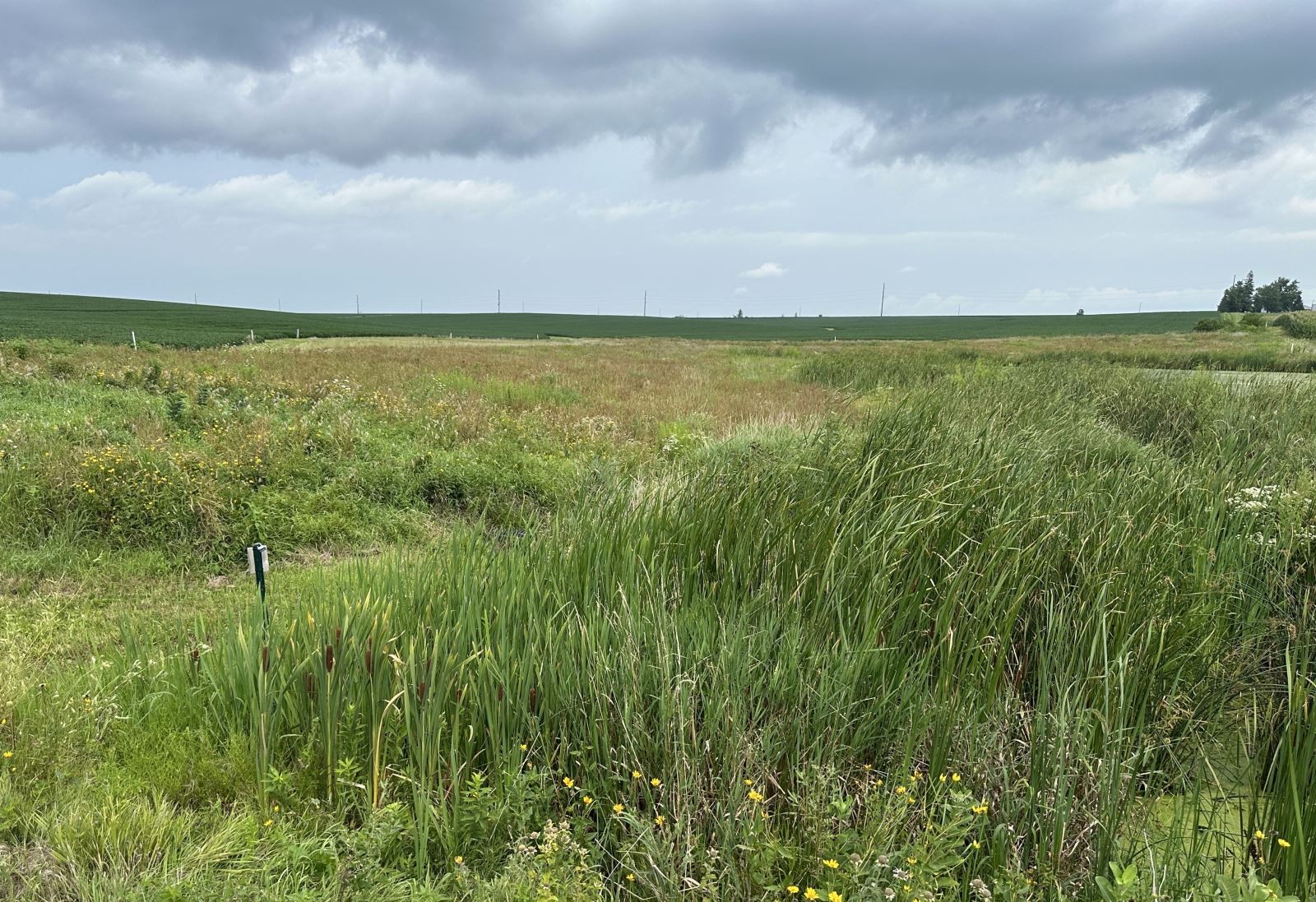
O'Connell's wetland drains into a tributary of Morgan Creek, which is located within the larger Cedar River watershed, meaning that water leaving his farm flows toward the drinking water source for the City of Cedar Rapids. The Iowa Nutrient Reduction Strategy says that roughly 93% of nitrogen in Iowa's waterways comes from nonpoint sources, such as agricultural fields. O'Connell is not blind to this fact; he treats it as a call to action. "The measure of a person is based on how much you help someone," he said. "I go to Cedar Rapids all the time, and I feel like [conservation practices on my farm are] helping each and every person."
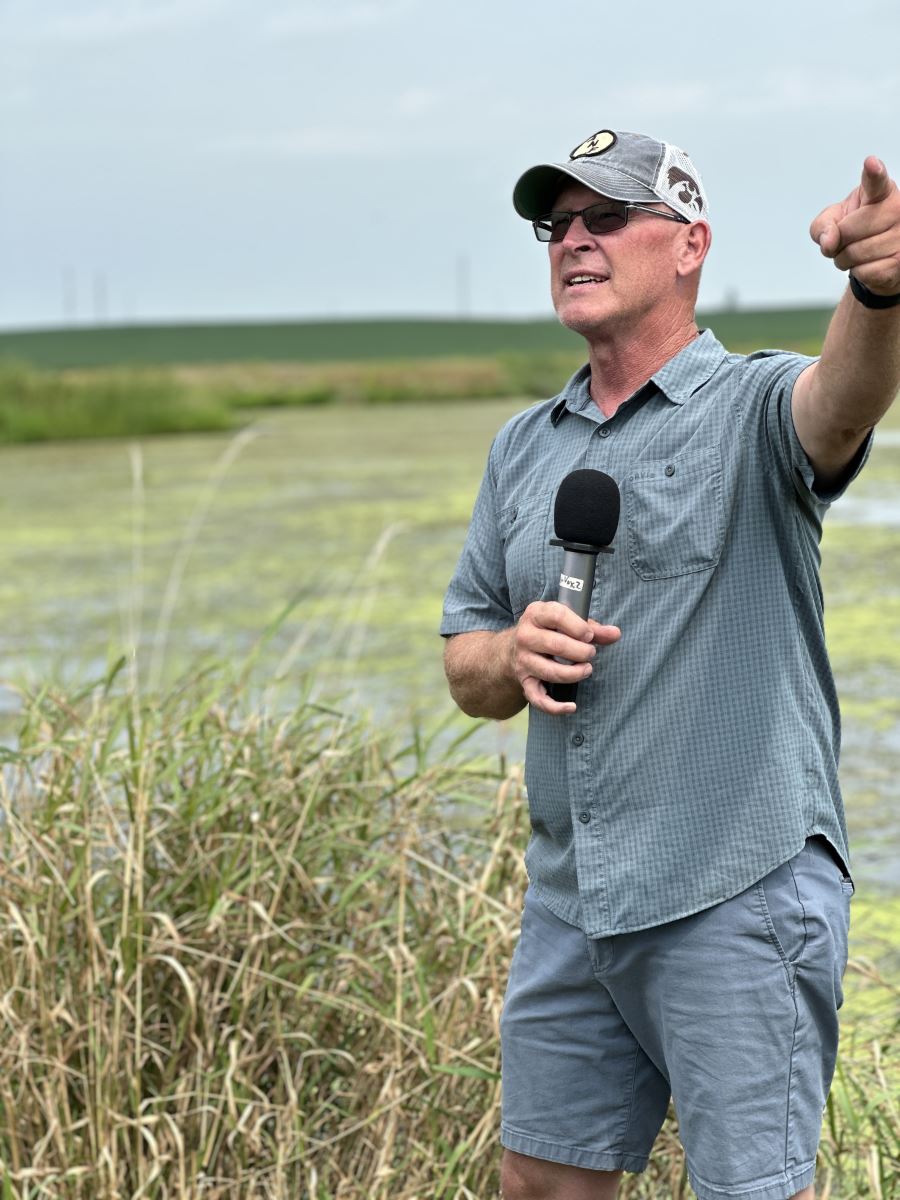 O'Connell was candid that cost-shares helped pay for only some of these improvements and equally clear that the expense is no excuse for skipping them. In fact, he believes that over the past 22 years, his yield increased because of these practices, not in spite of them. "Data drives everything," he said. The cover crops help keep the soil intact throughout the winter and spring months. Without cover, topsoil migrates downhill, and the hilltops get progressively poorer in soil quality. By holding that soil in place, he has narrowed the production gap between his hills and lowlands. He is also able to save on anhydrous ammonia costs — cutting his expense by almost 20 percent — by returning biomass to the soil. Additionally, the increased biodiversity from the wetland allows O'Connell to reduce his use of insecticides and rely more on natural predators.
O'Connell has partnered with IIHR at the University of Iowa, Iowa State University entomologists, the Middle Cedar Watershed Project, and many others interested in sustainable agriculture. He sees his farm and his neighbors' farms as living proof that these practices work, demonstrating to anyone who cares to ask that conservation and productivity can go hand in hand. He built the wetland to remove nitrate from tile water headed for the Cedar River. He achieved that outcome and, in the process, restored a once-lost ecosystem that supports his farming practices.
Jim O'Connell shows that accountability isn't measured by a single conservation practice. It's demonstrated through the discipline of building a system over decades by investing in the long-term work of leaving the land and water better than he found them.