2026 Iowa Beach Monitoring Recap: A New Record for Lost Recreational Time
posted
by Colleen Fowle on Friday, October 2, 2026
Beginning in 2000, the Iowa Department of Natural Resources (DNR) began systematically monitoring state-managed beaches for bacterial contamination. In 2006, the DNR began monitoring microcystin as well, giving Iowans a weekly look at two of the most important indicators of recreational water safety.
Every year, this data is uploaded to the DNR’s AQuIA site — a public portal with updated data released weekly from Memorial Day through Labor Day. Since 2014, IEC has tracked and reported beach advisory statistics to promote public safety and awareness of harmful pollutants in Iowa's recreational waters. With the summer 2026 monitoring season in the books, we close out another year of Iowa Water Watch with a more detailed look at this record-breaking year.
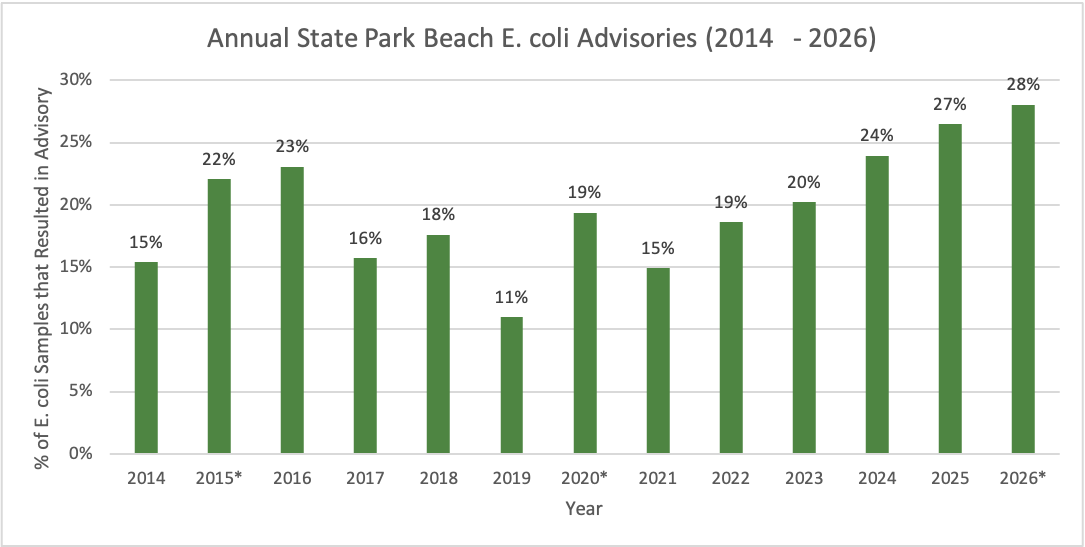
Source: Iowa Environmental Council analysis of Iowa DNR beach monitoring results
Graph based on the 15-week monitoring period between Memorial Day and Labor Day. An asterisk (*) indicates years with a 16-week monitoring period. Although 2026 had sixteen monitoring weeks, the season still had the highest percentage of samples that triggered a Swimming Not Recommended advisory.
Understanding what these advisories tell us requires looking beyond the weekly numbers to the larger forces affecting Iowa's waterways. Pollution, including runoff from manure and fertilizer applications, is a major contributor to the excessive nutrients in Iowa's degraded waterways. Septic systems and wildlife can also introduce E. coli and other fecal bacteria into waterways, but these sources do not contribute equally to the broader pollution problems that have thrown many of Iowa's aquatic ecosystems out of balance.
Once fecal bacteria enter a waterbody, what happens to them depends on the conditions they encounter because bacteria need nutrients to survive and grow. If excess nutrients from fertilizer and manure are present, they can "feed" algae and create an environment ripe for harmful algal blooms and bacterial growth.
The result can be a combination of fecal contamination, nutrient pollution, and algal toxins that compound water quality problems and make recreational waters unsafe.
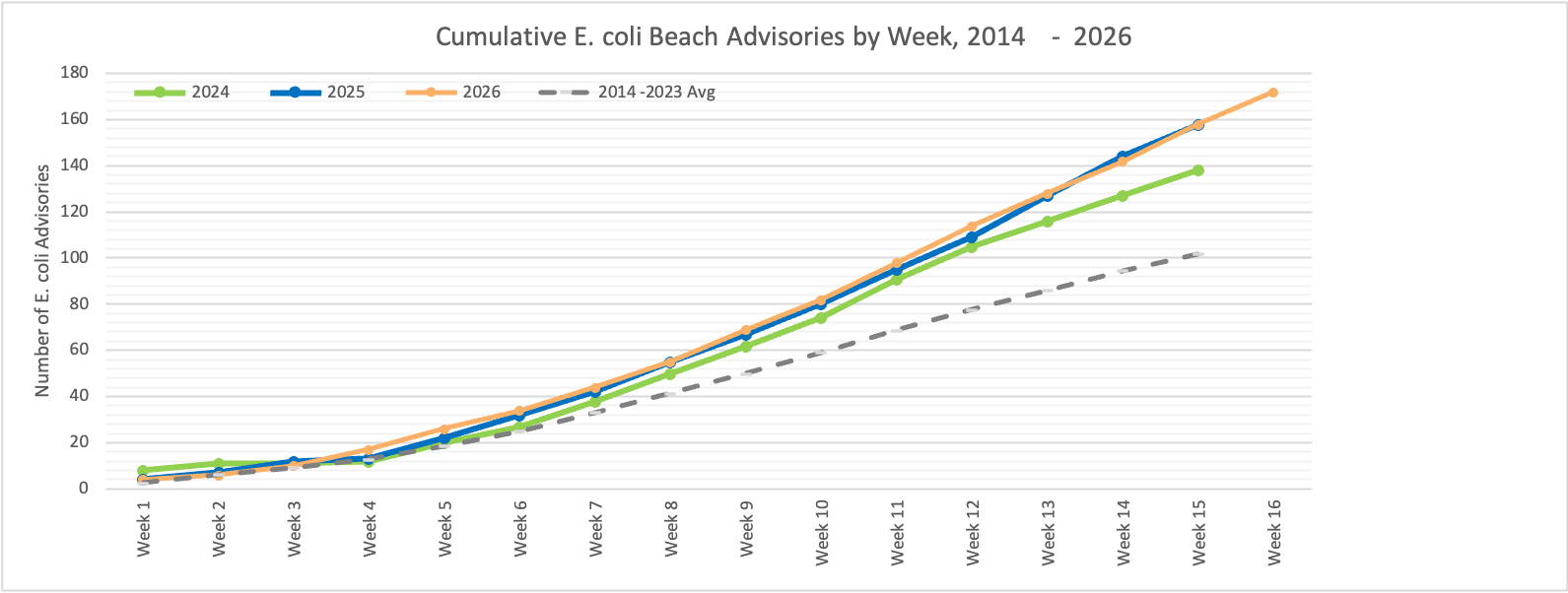
Source: Iowa Environmental Council analysis of Iowa DNR beach monitoring results
Many of these issues were explored in the weekly issues of Iowa Water Watch this summer, from Nitrate 101 through the history of Iowa's water pollution, updates from the Iowa Water Quality Information System, and an examination of four decades of Iowa fish kill data.
Statistics from 2026
- During the 16-week monitoring period, the DNR posted a record 182 advisories at state-owned beaches: 166 due to E. coli levels, 10 due to microcystin toxin, and 6 due to E. coli and microcystin toxin at the same beach site.
- Since IEC began tracking advisories in 2014, this past summer had the highest percentage of E. coli samples that triggered a “Swimming Not Recommended” advisory: 28%.
- An additional 27 samples tested over the single sample E. coli standard, but an advisory was not issued. For example, in May, Lacey-Keosauqua Beach had a sample that measured 17,000 CFU/100 mL, and in August, Orleans City Beach had a sample that exceeded the upper limit of the test’s reporting range, meaning the actual E. coli concentration was higher than 24,000 CFU/100 mL. Despite being several orders of magnitude greater than the single sample standard of 235 CFU/100 mL, the beach was still listed as “Ok for swimming.” This is because the DNR’s protocol means that a single high sample at a beach does not always result in signage. The DNR posts an advisory only at beaches it classifies as vulnerable or transitional; elsewhere, an advisory is posted only when the average of five weekly readings exceeds the standard.
- 27 out of 39 (69%) state park beaches had at least one E. coli or microcystin advisory between Memorial Day and Labor Day. Monitoring was suspended at two state park beaches—Blue Lake and Lake Keomah—due to low water levels for the entire summer monitoring period.
- Lake Darling Beach had the most weeks with a “Swimming Not Recommended” advisory. A combination of 13 E. coli and seven microcystin samples warranted an advisory for 15 of the 16 weeks during the summer season.
- Backbone Beach had the most E. coli advisories; for 14 of the 16 weeks of the summer monitoring period, swimming was not advised.
- In addition to 39 state park beaches, the DNR also monitored E. coli weekly at 39 city- and county-owned beaches through agreements with local entities. Those beaches recorded 101 E. coli exceedances over the state standard.
- During the same summer monitoring period, the U.S. Army Corps of Engineers – Rock Island District conducted weekly testing at six federally managed beaches on Saylorville Lake, Coralville Lake, and Lake Red Rock. They issued a total of 24 advisories for E. coli at Iowa reservoirs. If a single sample exceeded the standard, an advisory was issued and the beach would be retested two days later to collect more data and reevaluate the advisory.
- The U.S. Army Corps of Engineers – Kansas City District, which manages two beaches on Rathbun Lake, only tested for E. coli three times: the week before Memorial Day, the week before Independence Day, and the week before Labor Day. They do not test for microcystin unless a harmful algae bloom is suspected. (Note: The third public beach on Rathbun Lake—Honey Creek State Park Beach—is managed by the Iowa DNR, so it is tested weekly for E. coli and microcystin.)
- In total, local, state, and federal sites across Iowa recorded an astounding 340 contaminant exceedances (E. coli and microcystin) during the 16-week monitoring period—an average of about 21 exceedances per week.
Together, those 182 “Swimming not recommended” advisories amount to an estimated 18,500 hours of lost recreation time at state park beaches across Iowa in just three months — the equivalent of shutting down one beach continuously for three and a half years. During the hot summer months, Iowans in many parts of the state could not safely access their public beaches to enjoy a refreshing swim and cool off.
In a state with a limited number of public recreation areas and hot summers, access to beaches during hot summer months is critical. Water pollution is making it increasingly impossible for Iowans to safely access these taxpayer-funded resources.
Estimated lost recreation time was calculated by multiplying the number of days each beach had a posted advisory by 14.5 hours of available swimming time per day, based on the average daylight hours during the monitoring season.
The Beaches Nobody Tests
According to IEC's research, many local water bodies across Iowa are not regularly tested for E. coli and microcystin. Of Iowa's 133 total public beaches, only 35% are tested for both E. coli and microcystin on a weekly basis during the summer months, 27% for E. coli alone, and 38% are not tested at all. At those beaches, the DNR's monitoring program cannot issue an advisory, even if water quality makes swimming unsafe for people or pets. Iowa has no uniform protocol for testing recreational water, and coverage varies depending on which entity manages the beach and whether it's public or private. Our beach monitoring factsheet shows how unevenly the monitoring coverage is distributed across the state.
(2).png)
If your local city or county beach is not included in the DNR's monitoring database, contact the entity that oversees the beach and ask them to request that it be added to the DNR's list of monitoring sites for next year. There is no cost to the local entity for the testing itself: the DNR offers to monitor city- and county-owned beaches for free and covers shipping and laboratory analysis, though city-run beaches collect their own samples. The DNR contacts counties each spring to ask whether they want to participate, and a beach that misses that window has to wait until the following year, which makes the off-season a good time to ask. Expanding monitoring would make water quality results publicly accessible and give parkgoers information they can use to make informed decisions. The DNR's beach monitoring program can be reached at (515) 725-8200.
As always, report water that looks or smells unhealthy to your city, county, or the Iowa DNR. Pollutant levels, including E. coli and microcystin, can change quickly, even within a single day. Without thorough testing throughout the state, Iowans are left without the information they need to protect themselves, their families, and their pets. Exposure to E. coli and microcystin can have serious, even life-threatening consequences. For more information about protecting yourself and your pets, see IEC’s E. coli and Microcystin factsheet and Harmful Algal Blooms and Dog Health and Safety factsheet.
Thank you for following along with us for the past three months of Iowa Water Watch. We hope this series has helped you stay informed and safe while enjoying Iowa's recreational spaces this summer. Follow IEC's Water Program as we kick off our newly launched Protect Water, Prevent Cancer campaign and head into the 2027 legislative session, where we'll keep working toward cleaner, safer water and a healthier future for all Iowans.