A Valve at a Red Oak Co-op Stayed Open for 60 Hours. Two Years Later, Neighbors Are Still Testing the River.
posted
by Guest Blogger on Friday, August 28, 2026
On March 16, 2024, Kevin Eicher took his 10-year-old grandson out looking for somewhere to fish. They drove to a boat access on the East Nishnabotna, the river where he swam and fished as a kid. What they found at the ramp was a troubling site: dead fish all along the water. “As far as you could see up and far as you could see down,” he said. His first thought was winter kill, and then he decided it was something else, though there was no way to find out which. “There was no information,” he said. It was another week before his sister sent him an article about a fertilizer spill at a co-op in Red Oak.
Eicher had moved back to Sidney to reconnect with the county where he grew up, and what he found that day was not simply a degraded or neglected river. “It was dead,” he said. “It had been almost systematically killed.” Eicher talks about the river the way people talk about something they consider themselves accountable to, and when he reaches for a historical comparison, it extends past Iowa entirely. “I’m hoping this NEW Cooperative spill is our Cuyahoga moment,” he said.
NEW Cooperative, Inc., has a facility located in the city limits of Red Oak that has huge holding tanks of liquid fertilizers. According to reports issued by government officials, a valve was left open on one of those tanks over the weekend of March 8, 2024. Without a barrier to stop the flow, the fertilizer ran across the parking lot and through a pipe in the levee into the river, undiscovered for 60 hours. Reports put the release at 265,000 gallons and the toll at more than 750,000 fish along a 60-mile stretch of the East Nishnatbotna River, reaching into Missouri — the fifth-largest fish kill in Iowa history. March was not the end of it. Terry Langan, Co-President of the Nishnabotna Water Defenders, described two more releases based on written reports. The first came during the cleanup itself, when a rain event flooded the parking lot while crews were excavating contaminated soil along the creek bed, and the valve was reopened afterward. The second came in a May flood that carried another unrestricted release of chemical residue from the co-op into the river. At Riverton, where the two Nishnabotna branches join, residents were forced to stay indoors due to the overpowering smell.
The Iowa Department of Natural Resources (DNR) issued a notice of violation the following month, and the Environmental Protection Commission referred the case to the Iowa Attorney General’s office. Then the waiting began. What crystallized for Jodi Reese during that wait was that Red Oak was not the only community at risk of a large spill event. “If you look at a map of [agricultural] co-ops in the state, many of them are on waterways,” she said. “So this isn’t just a problem for our area.” In the year following the spill, Reese and Langan organized the Nishnabotna Water Defenders (NWD), an Iowa nonprofit membership corporation that focuses efforts in a watershed that runs 2,800 square miles across 10 counties.
On July 24, 2025, the state settled with NEW Cooperative in Montgomery County District Court. The company agreed to pay a $50,000 civil penalty and another $50,000 to the Montgomery County Conservation Board for habitat restoration, controlled burn equipment and native tree planting. It admitted the violations alleged in two paragraphs of the state's petition, for the purposes of that settlement and no other. The decree required no new safety measures at the Red Oak facility, and after three years the company can ask the court to end it.
The group’s first objection was arithmetic. The DNR maintains per-fish valuations for kills like this one and can assess daily penalties for non-compliance. DNR’s own initial estimate of the damage exceeded $225,000, which is more than twice what the State of Iowa ultimately required. Without the non-compliance penalties, the settlement values each fish at about 13 cents. Including the non-compliance penalties drops the value of each fish’s life even lower. “It could have been in the tens of millions, very easily,” Langan said. “With such minimal penalties, corporate Iowa polluter's view fines as simply a cost of doing business and not as a deterrent.”
In response, NWD began its own water quality testing within the East Nishnabotna watershed. The group’s members promote the Izaak Walton League’s Nitrate Watch program, which supplies free test strips to anyone willing to log results to the Clean Water Hub. Before the group existed, Southwest Iowa was a data gap on that map. It now lists 44 “community scientists” who are testing monthly, with Reese testing six sites herself. “Groundwater and surface water communicate,” Reese said. “What runs off the landscape reaches the river, and it reaches the aquifer people drink from.”
Some of the testing sites are deliberate. Because the settlement bars NEW Cooperative from further infractions for three years, volunteers sample upstream and downstream of the facility. This data collection allows NWD to determine whether the cooperative is complying with the settlement. “We’re acting as a watchdog for unreported spills,” Eicher said. “What the network shows so far,” Langan shared, “is nitrate levels going up.”
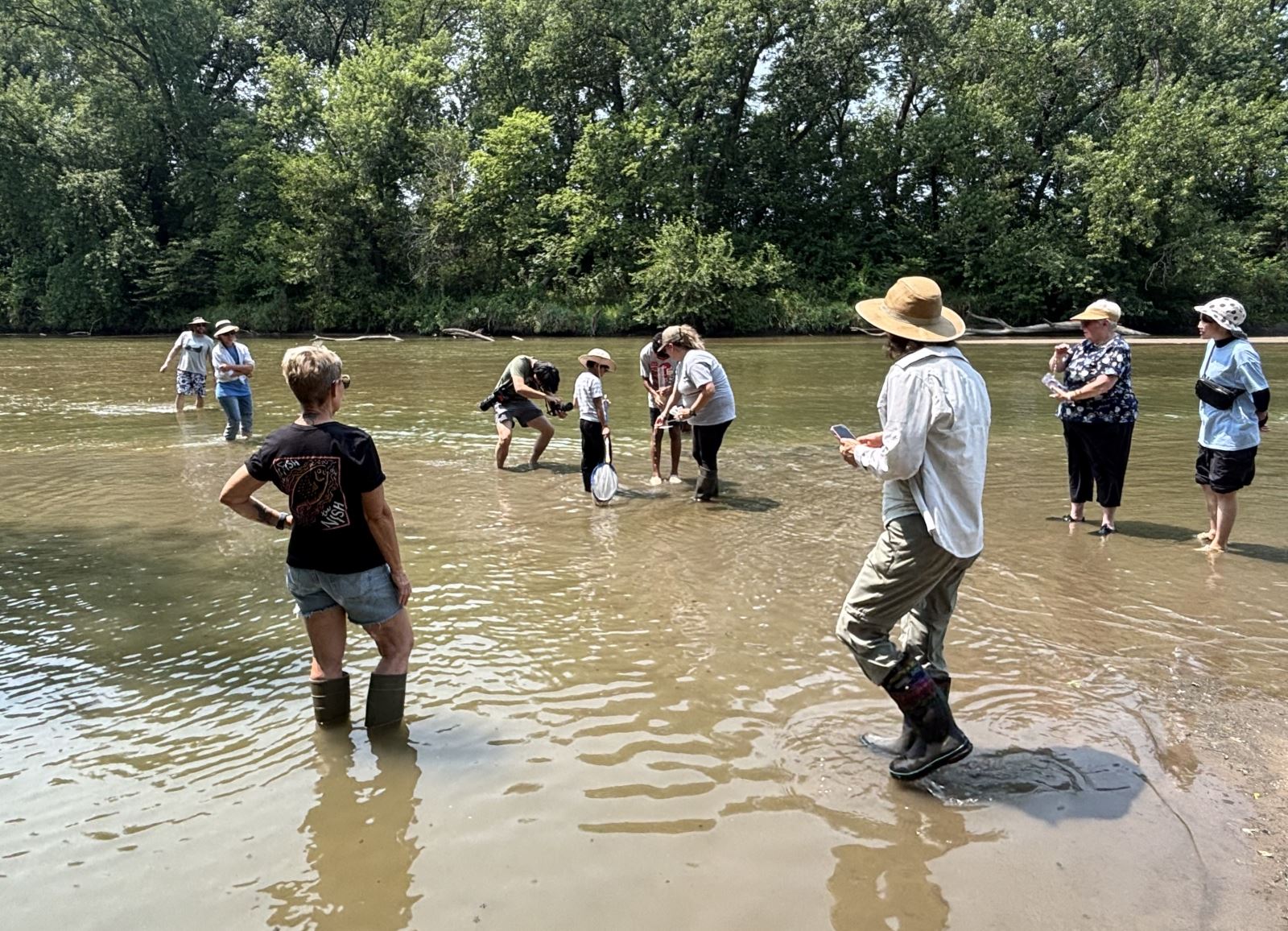
The evidence paints a complicated picture of the river’s journey to recovery. The DNR’s most recent completed fish sampling on the Nishnabotna (September, 2024) found channel catfish, but they were smaller than pre-spill levels. Eicher went looking for the agency’s own numbers and turned up a newer assessment, not yet final, reporting fish populations back to 100 percent within six months and macroinvertebrates at pre-spill levels. Then he read the fine print. Most of the fish counted are species that tolerate low oxygen, and both measures have been a concern on this stretch of river since 2010. “Nature’s pretty darn resilient if you give it half a chance,” he said, which is not the same as saying the river is healthy. “We’re just not willing to live with that anymore.”
The Nishnabotna has spent a century being drained, straightened, and turned into a ditch, and Eicher does not expect it to become pristine again. What he believes can be restored is the river’s connection to its floodplain and the wetlands that once fed it. Whether the spill becomes the Cuyahoga moment Eicher hopes for was not decided by the Attorney General’s office last July. It is being decided month by month, by 44 people with test strips.
About the Nishnabotna Water Defenders
.jpeg) On March 8, 2024 in Red Oak, Iowa, an agricultural co-op left open a valve on a liquid nitrogen tank, which led to 265,000 gallons of nitrogen-based fertilizer being released into the East Nishnabotna River. The damage was felt far downstream, eventually killing 750,000 fish along a 60-mile stretch of the river. More than a year later, little had been done to address the catastrophe or hold anyone accountable. In March 2025, the Nishnabotna Water Defenders formed. Modeled after the Iowa Driftless Water Defenders, the Nishnabotna Water Defenders is focused on one main goal: improving water quality in Southwest Iowa through public advocacy, education, and, when necessary, litigation.
On March 8, 2024 in Red Oak, Iowa, an agricultural co-op left open a valve on a liquid nitrogen tank, which led to 265,000 gallons of nitrogen-based fertilizer being released into the East Nishnabotna River. The damage was felt far downstream, eventually killing 750,000 fish along a 60-mile stretch of the river. More than a year later, little had been done to address the catastrophe or hold anyone accountable. In March 2025, the Nishnabotna Water Defenders formed. Modeled after the Iowa Driftless Water Defenders, the Nishnabotna Water Defenders is focused on one main goal: improving water quality in Southwest Iowa through public advocacy, education, and, when necessary, litigation.