Unlocking More Power from the Grid That We Already Have
posted
by Raihan Rashidi on Tuesday, March 17, 2026
After decades of relatively flat electricity demand, the United States is entering a period of rapid growth in energy needs. Electricity consumption is projected to increase by roughly 25-52% nationwide by 2044, with Iowa’s demand expected to grow even faster — by 40-76% — driven by increased building electrification, electric vehicles, data centers, and new industrial development. However, the country’s transmission system has not kept pace. Lengthy, multi-state permitting processes have slowed the development of new transmission infrastructure needed to deliver power reliably and respond to increasingly extreme weather events.
As a result, large amounts of new generation are waiting to connect to the grid, creating congestion and supply bottlenecks that drive up electricity costs. In the region operated by the Midcontinent Independent System Operator (MISO) — the regional grid operator responsible for managing the flow of electricity across 15 states, including Iowa — the interconnection queue currently includes 227 gigawatts (GW) of proposed generation projects awaiting study and approval. This backlog highlights the urgent need for solutions that can increase grid capacity more quickly.
This is where advanced transmission technologies (ATTs) come into play. ATTs are hardware and software solutions that increase the usable capacity of existing transmission infrastructure. They include high-performance conductors and grid-enhancing technologies (GETs) such as dynamic line rating, advanced power flow control, and topology optimization. These technologies use advanced materials, sensors, and control systems to enable more electricity to flow through the grid in a reliable, efficient, and cost-effective way.
Building a Reliable and Resilient Grid
GETs provide operators with new tools to improve grid reliability and resilience by unlocking the transmission system’s dynamic capabilities. For example, dynamic line rating calculates transmission capacity based on real-time weather conditions, while advanced power flow control and topology optimization help redirect electricity from overloaded lines to underutilized ones. These technologies balance power flows, increase operational flexibility, and provide more accurate data about available grid capacity, allowing operators to move beyond the traditionally used conservative static limits.
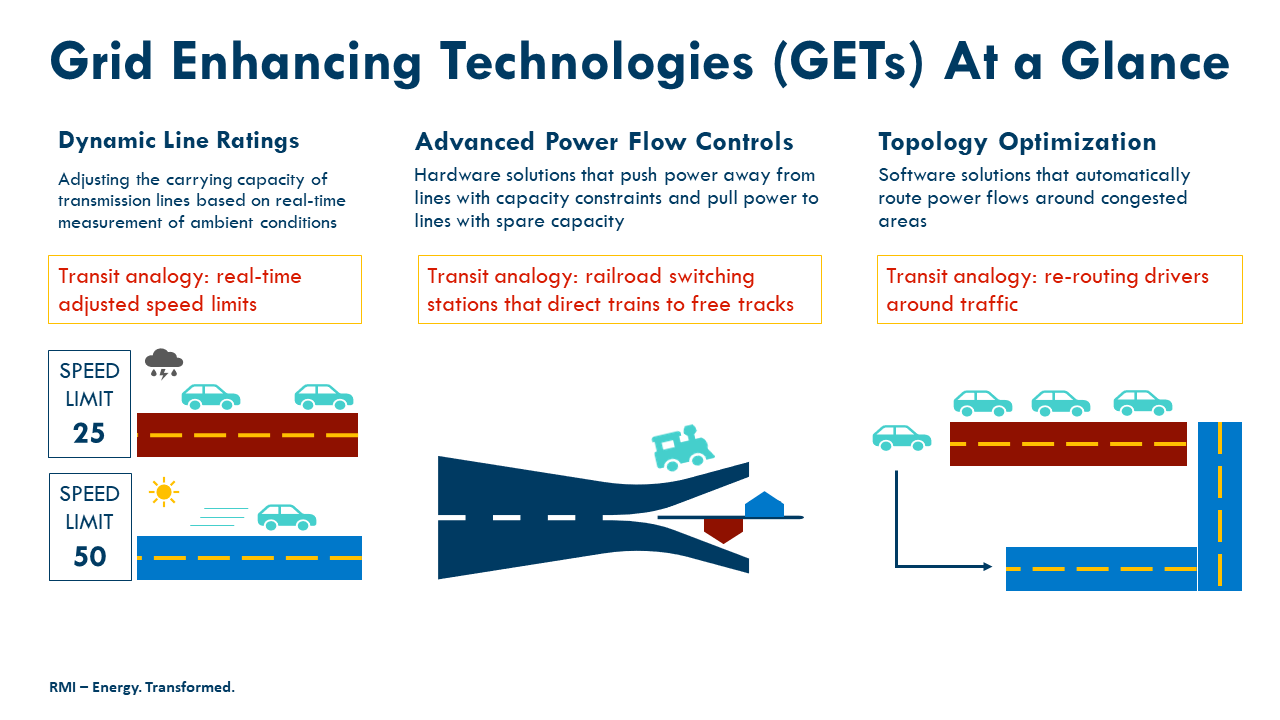
Source: RMI on technologies that increase existing grid capacity
In 2021, topology optimization was used in MISO to implement a grid reconfiguration solution that mitigated costs during a major transmission outage. This approach saved approximately $40 million over a nine-month period by reliably increasing transmission capacity by up to 56% in the region. The technology enabled electricity to be safely rerouted through other parts of the grid, maintaining reliability despite the outage of a transmission line. Such capabilities are increasingly important as energy demand grows and extreme weather events become more frequent.
Boosting Operational and Environmental Efficiency
Constructing new high-voltage transmission lines can take up to 10 years on average, while ATTs can be operational within months. As part of a pilot project in 2023, AES Indiana installed dynamic line rating on a historically congested transmission line. With an average installation time of just 30 minutes per sensor, the system delivered capacity gains averaging 43% above the static rating, rapidly improving electricity flow across the MISO network.
In addition to boosting operational efficiency, ATTs also enhance environmental efficiency. Building new transmission lines often requires developing previously undisturbed land, whereas ATTs make use of existing rights-of-way — legal easements allowing access across private property . This significantly reduces the time needed for permitting, land acquisition, and construction compared to building new transmission lines. While new transmission will still be necessary to meet long-term grid needs, ATTs complement those investments by delivering faster, more land-efficient capacity in the near term.
Driving Economic Benefits for Customers
When transmission capacity is limited, customers pay higher congestion costs because the grid cannot access the lowest-cost resources and must instead rely on more expensive generation. In 2022, congestion costs in the U.S. totaled an estimated $21 billion, directly increasing consumer electricity bills. By increasing the capacity of existing lines, ATTs enable more low-cost generation — such as solar and wind — to connect to the grid and deliver power to customers. This is especially important in MISO, where approximately 80% of projects in the active interconnection queue consist of renewable energy and storage.
While MISO has implemented queue reform efforts to accelerate the interconnection process, ATTs remain a cost-effective solution to relieve congestion and reduce customer costs. Between 2021 and 2023 in Iowa, topology optimization was used to identify grid reconfigurations, saving Alliant Energy customers $24 million and reducing congestion costs by 49%. Total savings could be even greater if additional reconfigurations were implemented. These results highlight the potential for ATTs to reduce bottlenecks and deliver significant cost savings across Iowa and the broader MISO region.
Planning a Smarter Grid for Iowa’s Future
It is clear that ATTs offer a practical path to a stronger and modernized grid, but existing regulatory structures incentivize costly capital investments (e.g. building new transmission lines) over optimizing the infrastructure we already have. However, in the past year, states such as Ohio, Indiana, and Utah have adopted policies that promote the use of ATTs. Iowa is currently considering a similar step with House File 2682 that would require transmission companies to study the feasibility of GETs and reconductoring every three years. This creates a proactive and transparent process to evaluate how much additional capacity the existing grid can cost-effectively deliver at a time when reliability and affordability are under increasing pressure.
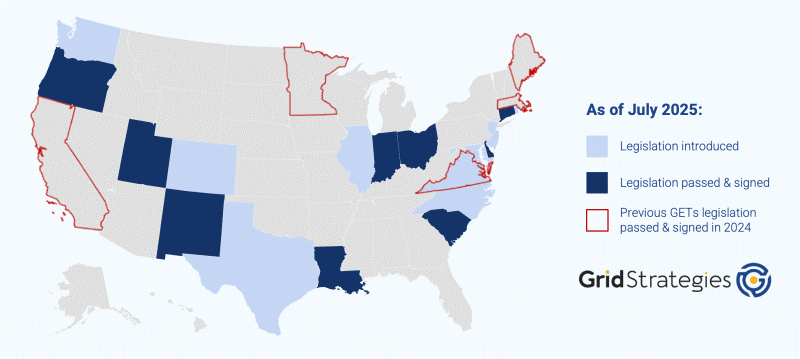
Source: WATT Coalition by Grid Strategies on States’ GETs Legislation
Critics may claim ATTs are expensive and risky, but real-world examples prove otherwise. These technologies are commercially viable and often deliver tangible, lasting benefits that extend well beyond the costs of installation and operation. When deployed strategically, ATTs can efficiently tap into cheaper energy sources, multiplying savings for ratepayers while making the grid more reliable and resilient. With much of the U.S. grid aging and constrained, using advanced technologies effectively depends on smart planning and aligned incentives.
Federal guidance, such as FERC Order 1920, directs transmission providers to consider ATTs in their planning. While this order is not yet fully enforced and does not require technology adoption, it signals a clear policy trend toward modernizing the grid efficiently. HF2682 closes the gap by requiring consistent, publicly accessible information that Iowa regulators and stakeholders can review and use to guide decision-making.
If you believe Iowans deserve a more transparent, structured approach that maximizes grid benefits for ratepayers, urge your legislator to support HF2682.