Member Highlight: Iowa Stormwater Education Partnership (ISWEP)
posted
by Guest Blogger on Thursday, July 23, 2026
In Iowa, we hear a lot about how agricultural runoff affects our water quality, and for good reason. But our cities and towns have an impact too.
When rain falls on a rooftop, street, or parking lot, it does not soak into the ground the way it would in a prairie or field. Instead, much of it runs off. Along the way the runoff picks up whatever is sitting on those hard surfaces: oil, grease, fertilizer, pesticides, grass clippings, road salt, sediment, and litter. In most Iowa communities, that runoff enters a storm drain and flows directly to the nearest creek, river, or lake without any treatment. And because hard surfaces shed water so quickly, urban areas also send more water downstream, all at once, than the same land would in its natural state. That extra water contributes to flooding and erodes stream channels.
Addressing urban stormwater runoff is the sole focus of the Iowa Stormwater Education Partnership (ISWEP). Among Iowa's many water quality organizations, ISWEP occupies a specific niche. We work only on urban and municipal stormwater, partnering directly with cities to protect the water that flows through and beyond their communities.
How urban stormwater is regulated
Many people may be surprised to learn that urban stormwater is one of the few sources of non-point runoff that is actually regulated under the federal Clean Water Act. Cities with municipal storm sewer systems, known as MS4 communities, must obtain a permit just to discharge stormwater to Iowa's waterways. This is a major contrast to agricultural systems which have no comparable requirement.
MS4 permits come with real obligations. Communities must educate their residents about stormwater pollution, involve the public in their programs, find and eliminate illegal discharges to the storm sewer, manage runoff from construction sites and new development, and keep their own municipal operations clean. For a small city with a lean staff, meeting all of these requirements can be overwhelming.
That challenge is why ISWEP was founded in 2005, as new Clean Water Act requirements were being implemented in Iowa. Rather than every community building its own education program from scratch, cities pooled their resources to create shared tools, training, and technical support. Today ISWEP serves more than 75 member organizations across the state, including cities, counties, universities, and professional firms.
Education and outreach
Our mission is to enable everyone to value and improve water quality through education and technical services. In practice, most of what happens to urban water quality comes down to individual choices: how homeowners maintain their lawns, how a contractor manages a construction site, how a restaurant handles grease, how a snow removal company applies salt.
ISWEP develops educational materials that member communities use locally with these audiences. That includes resources for homeowners on lawn care, native plantings, and rain gardens; guidance for businesses like auto shops, landscapers, and food service operations on keeping pollutants out of storm drains; and materials for city staff and elected officials who make decisions about stormwater programs and budgets. Members can adapt these resources to their own communities instead of developing them independently, which saves staff time and keeps the message consistent statewide.
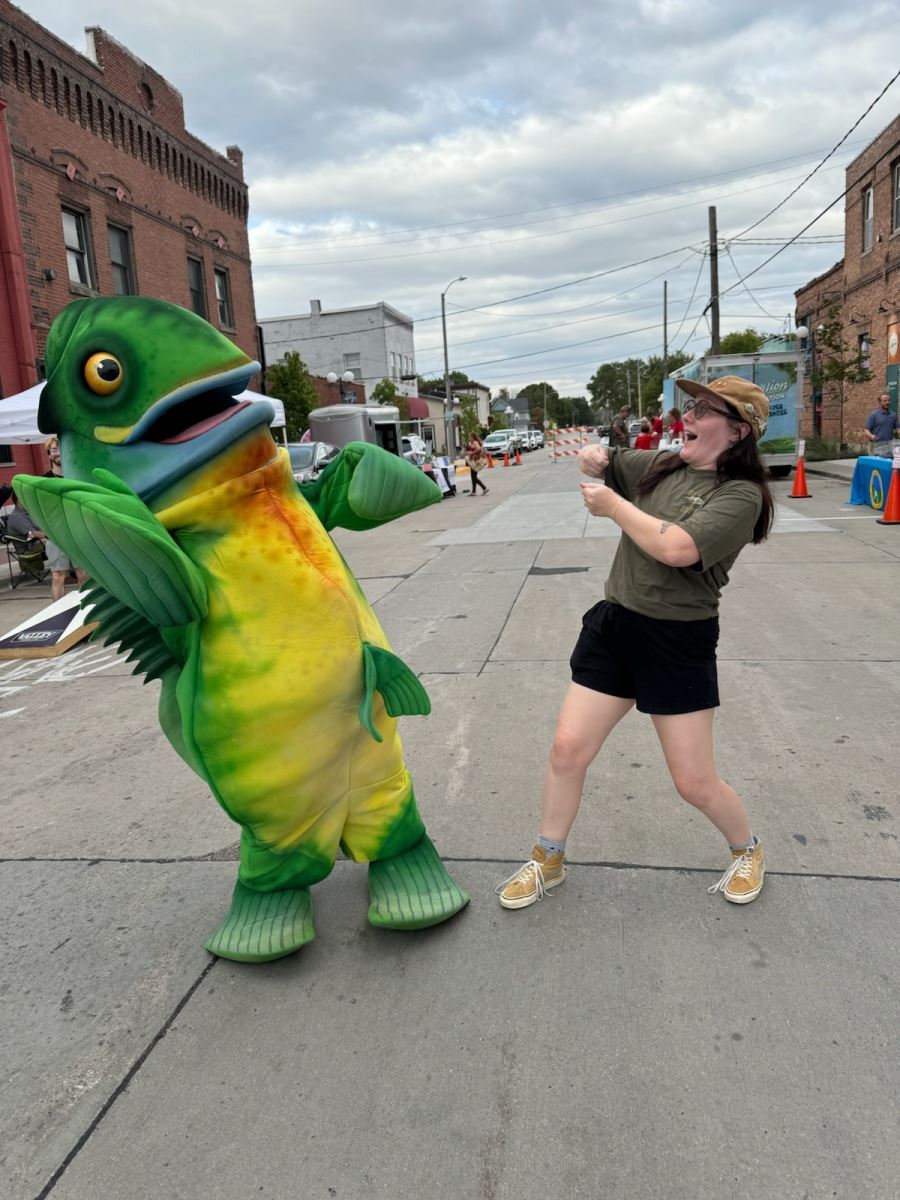
Gill, ISWEP's stormwater mascot, dances with a community member at a local farmers market. The Gill costume is one of many education resources member communities can borrow for their events.
Training and green infrastructure
Alongside education, ISWEP runs statewide certification and training programs. These set a consistent standard for the people who design, install, inspect, and maintain stormwater practices in Iowa. Our programs train construction site inspectors, stormwater plan designers, maintenance staff, and winter salt applicators, among others. We hold more than 20 training events each year across the state.
A growing part of our work is helping communities adopt green infrastructure and nature-based solutions. Practices like soil quality restoration, bioretention cells, permeable pavement, and stormwater ponds can capture and clean up rain where it falls instead of sending it downstream. The science and technology in this field continue to advance, and ISWEP works to move that research into practice. We help municipalities understand which practices fit their situation, how to install them correctly, and how to maintain them so they keep working for decades.
Partnering across Iowa
No single city can solve urban stormwater problems on its own, and no single organization can address all of Iowa's water quality challenges. ISWEP is proud to be a member of the Iowa Environmental Council and to work alongside the many organizations in this network. Our piece of the puzzle is urban stormwater, and we believe that when cities, residents, and businesses understand where their runoff goes, they make better choices for Iowa's waters.
To learn more about ISWEP, our member communities, and our training programs, visit https://iowastormwater.org.
About the Author

Loulou Dickey is the Executive Director of the Iowa Stormwater Education Partnership, a statewide nonprofit serving more than 75 cities, counties, universities, and professional firms. She works to turn scientific research into practical tools that help Iowa communities protect water quality and meet stormwater permit requirements. She earned a Ph.D. in Civil Engineering from Iowa State University, where her research focused on urban and agricultural water management.