Nature's Treatment Plant: Cedar Rapids' Decade-Long Bet on Working Land Conservation
posted
by Guest Blogger on Thursday, July 16, 2026
Cedar Rapids draws its drinking water from shallow wells fed by the Cedar River, which means what happens on farmland upstream matters directly to the more than 260,000 people as well as business and industries our water system serves. Two things fundamentally changed how we think about that relationship. The first was the devastating Flood of 2008. The second was a growing concern with nitrate levels in our aquifer. Together, they led us to a framework developed by the US Water Alliance called the One Water approach — the recognition that sustainable water management depends on the health of the entire watershed, not just what happens at the treatment plant.
That shift in thinking led to Cedar Rapids' first official watershed initiative: the Middle Cedar Partnership Project, launched in 2015 in close partnership with the Iowa Soybean Association and the Iowa Department of Agriculture and Land Stewardship. In 2021, we were awarded a second round of USDA-NRCS funding for the Cedar River Source Water Partnership, which includes 13 partners and leverages over $15 million in state and federal funding for conservation practices on farms. Since then, our achievements include 391,202 acres of cover crops, 9 wetlands, 4 oxbows, and 2 prairie strips.
Our newest effort, the Growing Resilience in the Middle Cedar Watershed project, is funded through a $1.29 million grant from the US EPA's Farmer to Farmer program. We are partnering with the Middle Cedar Watershed Management Authority, IIHR at the University of Iowa, the Iowa Geologic Survey, and The Nature Conservancy to identify opportunities for nature-based solutions across the watershed.
While infrastructure enhancements to the city's flood control system, drinking water plant, and wastewater treatment facility are critical for protecting residents and businesses, nature-based solutions are an essential element of the equation as well. Our watershed projects promote a whole-farm approach to conservation that weaves nature-based solutions into traditional farm operations. In-field practices, such as cover crops and no-till, protect soil health, reduce erosion, trap nutrients, and allow for improved infiltration of stormwater back into the aquifer. Edge-of-field practices, such as bioreactors, saturated buffers, and oxbows, are essential for capturing nitrate that escapes farm fields through tile drainage. Our Edge-of-Field partnership with IDALS has resulted in 50 denitrifying bioreactors and 38 saturated buffers installed since 2024.
Wetlands are the gold standard for conservation practices, providing significant benefits for nitrate reduction as well as flood reduction and wildlife habitat. While they do take land out of production, they can be sited in areas that are not as productive for growing corn and soybeans.
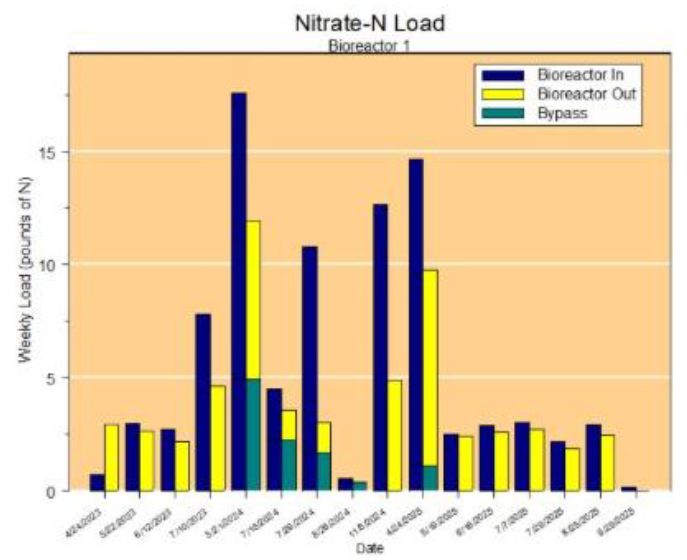
The data backs this up. Our water monitoring partnership dates back to the early 2000s and has included Coe College, Iowa DNR, Iowa Soybean Association, Linn County, University of Iowa, and USGS. Results from our monitoring program since 2017 are publicly available at cleanwaterhub.org. Over time, our data have revealed that individual practices such as bioreactors, saturated buffers, and nutrient removal wetlands are making a significant difference in water quality at the field scale. For example, data from the Iowa Soybean Association shows a bioreactor located in our source water protection area is achieving an overall 35% load reduction in nitrate levels.
Data from the Iowa Soybean Association similarly shows the significant reductions in nitrate levels due to a nutrient removal wetland — with outflow consistently below the 10 mg/L safe drinking water standard even as tile drainage levels exceed it.
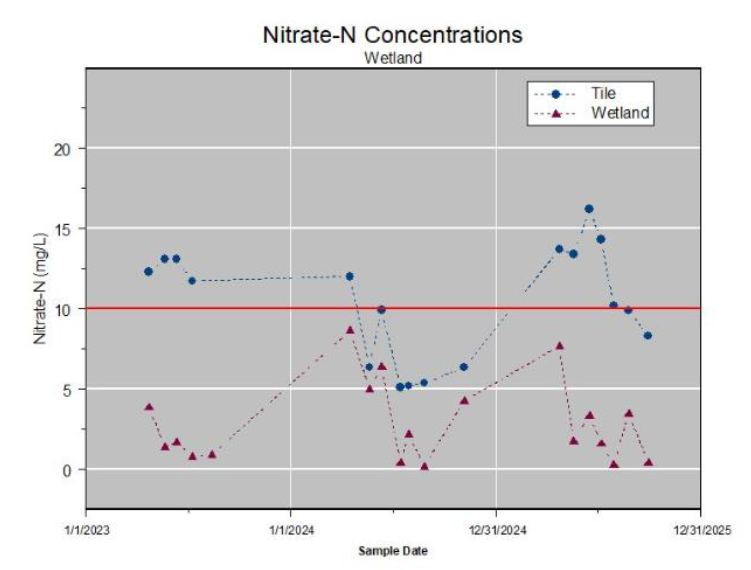
However, our data also show that nitrate continues to be an urgent issue in the watershed, with nitrate levels in 2024 and 2025 at the highest concentrations seen to date in our monitoring program. These findings underscore that in order to move the needle on water quality, we need to dramatically increase the number of farms adopting a diverse suite of conservation practices.
We all live in a watershed, and we all share responsibility for protecting our water resources. Our programs have been successful because we are working to build a shared watershed identity in which people take pride in being part of the solution. For communities facing similar challenges, the first step is to identify partners and develop a shared narrative around water quality and quantity goals. If possible, investing in staff to facilitate partnership activities can really help move efforts forward.
Over the years, I have observed that people tend to get overwhelmed by the magnitude and scale of Iowa’s water quality issues. For farmers in particular, there is a vast array of conservation options and government programs, all of which can be tricky to navigate and often times involve a steep learning curve. I have come to realize that the more we can help break down the complexity and eliminate barriers to entry, we will help people understand specific actions they can take in order to make a difference.
About the Author
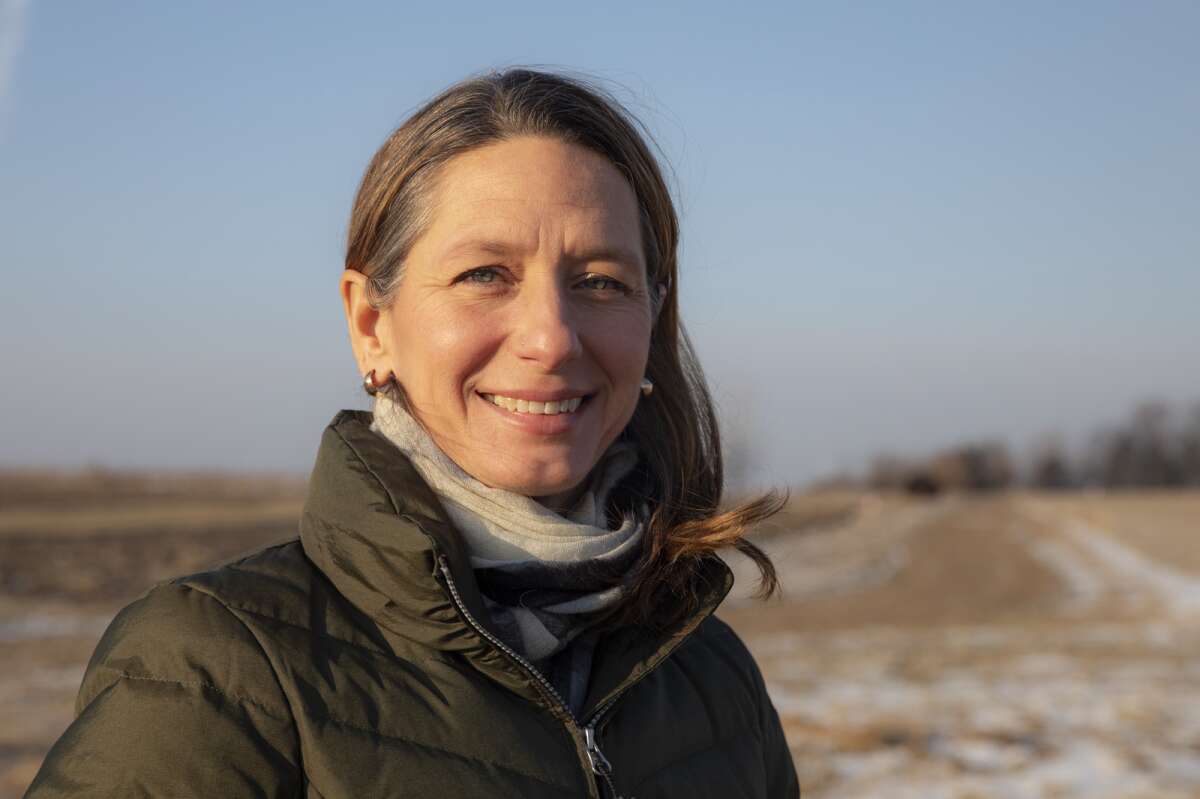
Mary Beth Stevenson has served as the Watersheds & Source Water Program Manager for the City of Cedar Rapids since 2019. She leads the City’s engagement in watershed-based efforts to improve water quality and reduce flood risk. This includes grant writing and management, building relationships with upstream producers and agricultural communities, and coordinating the City’s participation in the State of Iowa’s Nutrient Reduction Exchange. She is currently the Chair of the Middle Cedar Watershed Management Authority and also serves on the board of the Indian Creek and Lower Cedar Watershed Management Authorities. Prior to her role with the City of Cedar Rapids, she worked for 10 years for Iowa Department of Natural Resources. Ms. Stevenson holds a master’s degree in conservation biology from the University of Michigan and a bachelor’s degree in biology and religious studies from Grinnell College. If she isn’t at work, she is probably getting dirty in her garden, hanging out with her family, reading/knitting with a cat in her lap, or on a hike or bike ride.