Preserving IWQIS is Critical to Understanding Iowa's Water Quality
posted
by Guest Blogger on Friday, August 14, 2026
For the past decade, anyone with an internet connection could access data about nitrate levels and other water quality indicators in Iowa’s waterways in real time, via sensors that automatically updated a public dashboard every 15 minutes. Whether those in-stream monitors — and the data they provide to the public — continue in the future is an open question. IIHR—Hydroscience and Engineering at the University of Iowa have been nationwide leaders in developing a network of real-time technology that measures nitrate, turbidity, and other parameters at nearly 70 sites across the state. These sensors are placed in major rivers, smaller tributaries, springs, and downstream from edge-of-field nutrient reduction practices. The data are displayed on the Iowa Water Quality Information System (IWQIS) website, along with readouts from 19 additional sensors operated in Iowa by the U.S. Department of Agriculture and U.S. Geological Survey sensors.
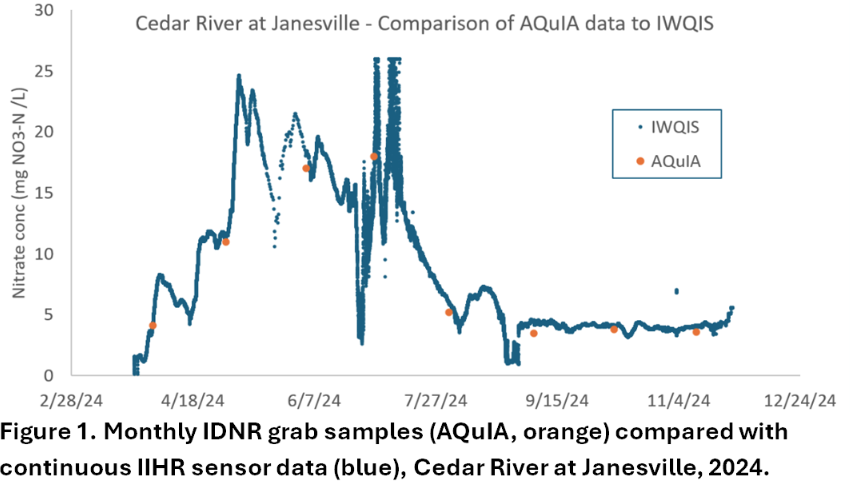
These data, reported every 15 minutes, lets IWQIS users assess Iowa’s waters as conditions change, rather than waiting two months for laboratory analyses from monthly grab samples. As shown in Figure 1, continuous monitoring values align with the IDNR’s monthly AQuIA data but capture short-duration spikes that grab samples miss entirely (see Figure 1). This continuous record allows researchers to better understand how nitrate concentrations respond during large precipitation events.
These rising nitrate levels in Iowa’s surface waters have been of increasing concern. Waters leaving Iowa contribute a disproportionate amount of the overall nitrogen load entering the Gulf of Mexico — leading to hypoxia (low oxygen) in the water. National Oceanic and Atmospheric Administration (NOAA) scientists predict that the 2026 Gulf “dead zone” will be larger than average, covering an area slightly smaller than the state of New Jersey. In the past two years, high nitrate levels in the Des Moines and Raccoon rivers have led to water use restrictions from Central Iowa Water Works because its nitrate removal system can only treat a portion of the water demanded and maintain drinking water below the EPA limit of 10 mg/L of nitrate-nitrogen (NO3-N). A growing body of epidemiological research has linked long-term exposure to nitrate well below the EPA standard to elevated health risks, including certain types of cancers (IEC, 2026). As Iowa continues to push for voluntary engagement for nutrient-reduction strategies, a continuous monitoring system provides a way to evaluate whether those programs are working.
Since the legislature removed funding from the network in 2023, bridge funding from the Walton Family Foundation allowed IIHR to continue its monitoring efforts for Iowans. As that grant expired earlier this summer, IIHR is encouraged that Iowa counties and municipalities have stepped up to support the program through 2027. Financial supporters include Polk County, Johnson County, Johnson County Conservation Board, Linn County Conservation Board, Wright County Conservation Board, City of Decorah, Dubuque Soil and Water Conservation District, Dubuque County, Dubuque Area Land and Water Legacy, and Friends of Jackson County. In addition, the Iowa Izaak Walton League spearheaded a GoFundMe page that raised over $70,000 from individual donors. IIHR deeply appreciates the support of these local governments, organizations, and individuals in keeping this network running. 
Funding beyond next year’s season remains uncertain. The state legislature considered restoring some funding during the most recent legislative session but decided in the final hours to redirect those funds to the IDNR. The local funds raised this past year were for one year and, with local budgets coming under increasing pressure, are certainly not a long-term solution. The lack of stable long-term funding hampers efforts to plan for the network’s future. IIHR has kept the program staffing lean to reduce costs, and many of the sensors are approaching the end of their useful life so are in need of replacement.
The support from organizations and individuals across the state this past year was a genuine bright spot for the researchers operating the network; but Iowa’s surface water problems are not going away. Solving them depends on knowing where the problems are and whether they are getting better. That requires a reliable, publicly accessible record — and right now, that record is being supported one year at a time. Restoring stable, statewide funding will take sustained public pressure. Look up river data from a sensor located near you at iwqis.iowawis.org; then contact your legislator and ask them to restore funding in the upcoming state budget.
About the Author
 Martin St. Clair is a Research Scientist with the University of Iowa’s IIHR—Hydroscience and Engineering and the Center for Health Effects of Environmental Contamination (CHEEC). His research focuses on water quality, environmental contamination, and watershed processes, with an emphasis on understanding nutrient transport and improving water quality in Iowa. He brings experience in field monitoring, environmental data analysis, and watershed-scale research.