Radon in Iowa: The Hidden Carcinogen We Can No Longer Ignore
posted
by Cody Smith on Wednesday, January 14, 2026
This guest blog comes from Jason Semprini, an Assistant Professor of Public Health at Des Moines University, and Cody Smith, IEC's Director of Climate Initiatives. They incorporate research analyzing environmental exposures, such as radon, on health outcomes and equity.
When we think about our environment, we often think about our air, our water, and, in Iowa especially, we think about our soil. In terms of agricultural health, Iowa was gifted with some of the healthiest soil in human history. Yet, buried in the soil that has sustained life in Iowa for millennia lays another naturally occurring element: radon. From a geological perspective, our time in Iowa is but a blink of an eye. Conversely, radon, a radioactive compound formed by decaying uranium and radium, has remained and will continue to remain long after we are gone. If left alone, radon seeps up from the soil into our homes, schools, and places of work, where we breathe in radon. Radon can also contaminate our water. Once inhaled or consumed, radon breaks down in our body, emitting radioactive particles that can damage our DNA. Prolonged elevated exposure to radon can result in lung cancer. According to the EPA, the entire state of Iowa, including every one of our 99 counties, has elevated radon levels.
FIGURE 1: AVERAGE RADON LEVEL IN IOWA COUNTIES
.png)
Radon in Iowa
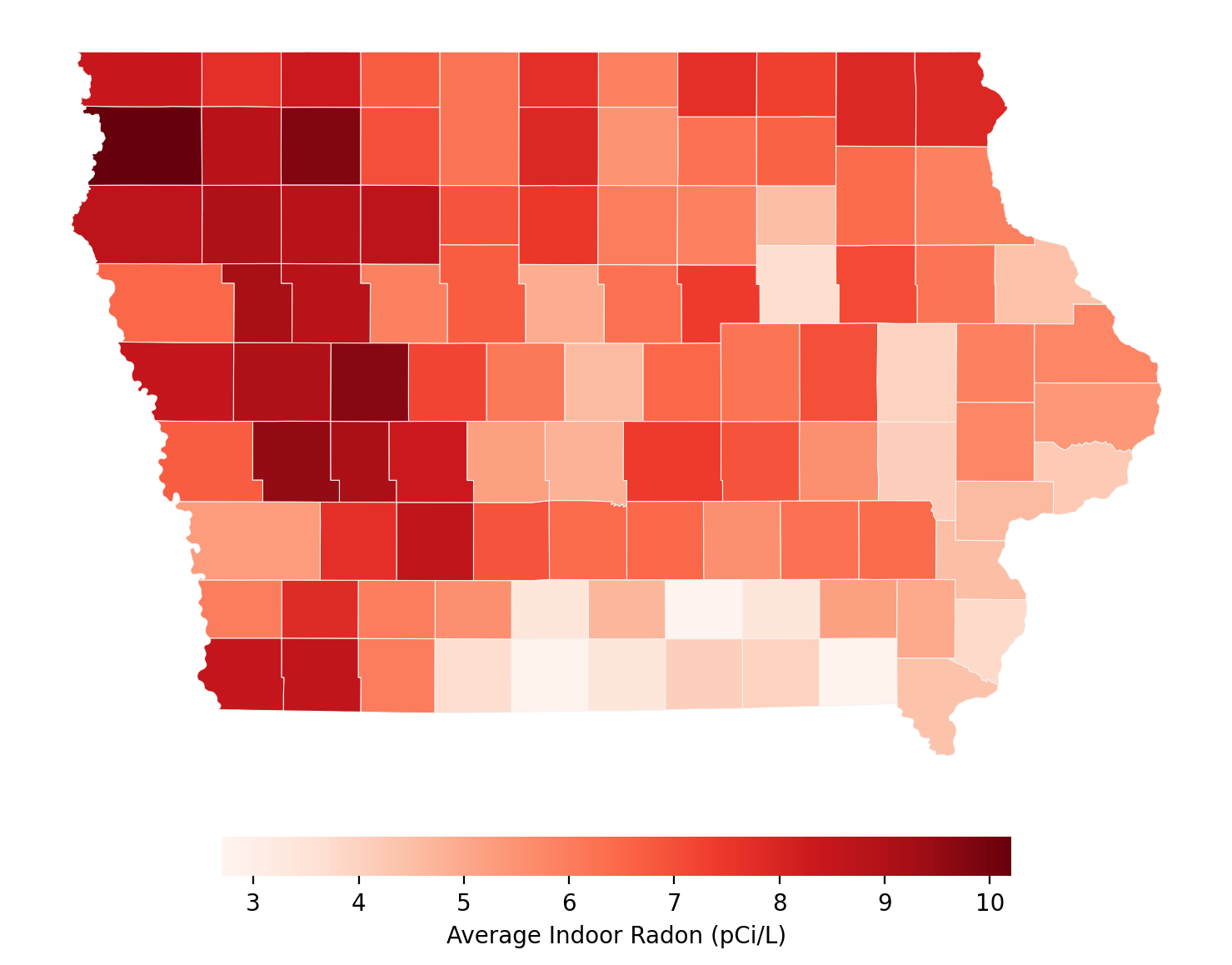
Yet, these simple categories mask the true burden facing Iowans today. Radon above 4 pCi/L of air is considered “elevated”. The average national indoor radon level is 1.3 pCi/L. In Iowa, the average indoor radon level is 6.4pCi/L. On average across all Iowa counties, 50% of the population are exposed to elevated indoor radon levels. These statistics are over twice as high as the rest of the United States. Again, these state statistics do not tell the whole story [Figure 1].
In Carroll County, where Jason is from, the average indoor radon level is 9.7. Ninety counties are above the elevated level, with disproportionately high radon on the western part of the state [Figure 2]. To be very clear, we have a radon problem in Iowa.
Radon and Lung Cancer in Iowa
According to the Iowa Cancer Registry, lung cancer is a leading driver of Iowa’s 2nd highest and fastest rising cancer incidence in the country. With little doubt, radon is a key contributor to Iowa’s cancer burden. While smoking remains the #1 cause of lung cancer, radon is a close second, and in people without a history of smoking, radon is the leading cause of lung cancer. In people who currently smoke, or in those with a history of smoking who have quit, radon exposure substantially increases the risk of lung cancer. In fact, the lifetime risk of death from lung cancer in smokers is nearly nine times higher in ever-smokers (7 per 1,000 people versus 62 per 1,000 people) than in never-smokers when exposed to 4 pCi/L according to the EPA. Either way, as smoking rates continue to fall, the negative impact from radon on lung cancer in Iowa becomes more pronounced. States, like Iowa, with elevated radon levels consistently have higher incidence of lung cancer. In fact, for females especially, lung cancer is declining everywhere…except in states with elevated radon.
FIGURE 2: AVERAGE INDOOR RADON BY COUNTY
Radon and Other Cancers
While radon’s role in causing lung cancer is well understood, there is emerging research that indicates the carcinogen plays a role in developing other cancers, including stomach and skin cancers. For example, the presence of radon in drinking water prompted the U.S. EPA in 1999 to propose a maximum contaminant level (MCL) under the Safe Drinking Water Act of 300 pCi/L of water. Though never finalized and adopted, this rule cited the reduction of internal organ cancers, specifically stomach cancer, as the main reason to adopt the requirement. The National Academies 1999 risk assessment of radon in drinking water also suggests that 11 percent of the 168 cancer deaths per year associated with ingesting radon-contaminated drinking water are from radon-induced stomach cancer.
Furthermore, recent studies have demonstrated that radon may play a role in skin cancers, including melanoma, due to skin receiving the second-highest annual dose of radiation exposure from radon and its decay products following the respiratory system.
Responsive, Innovative Policy
Although we cannot remove the radon from our environment, there is much we can do in terms of preventing and mitigating exposure to this potentially lethal carcinogen. In general, there are three ways to address the radon exposure that is fueling Iowa’s cancer crisis; education, testing, and mitigation. Each of these demand a policy response that is adaptive, effective, and informed if we are to make meaningful progress.
Improving Radon Testing
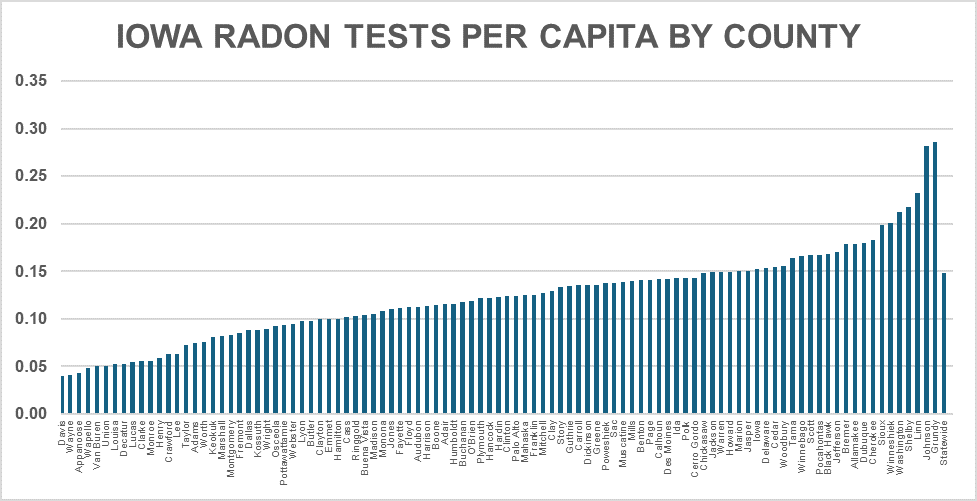
There exists a massive disparity in the amount and frequency of radon testing conducted across Iowa’s 99 counties, with a seemingly randomized mix of both urban and rural counties having considerably lower rates of testing per capita. In fact, 72, or more than two-thirds of Iowa’s counties, have lower radon testing per capita than the statewide average number of tests per capita between 2000 and 2024 for pre-mitigation tests, according to the Iowa Department of Health and Human Services.
To facilitate greater access to testing, the Iowa Environmental Councils is recommending that the Iowa Legislature allocate at least $120,000 annually to cover the full cost of 8,100 tests per year; this was based on the demand of 675 tests/month seen with last year’s allocation of $20,000 for this purpose. In addition, to streamline delivery and co-locate environmental health initiatives, the state could consider directing that money to the Private Well Testing Program (a.k.a. Grants to Counties Well Water Program) administered by the Iowa Department of Natural Resources and IHHS and adding radon tests as a covered expense.
FIGURE 3: IOWA RADON TESTS PER CAPITA 2000 - 2024
Mitigating Radon Exposure
Once Iowans have conducted a radon test in their homes, it is crucial they are afforded the opportunity to do something to mitigate this threat. As such, there is a need for innovative solutions for aiding the finance of radon mitigation systems. One example—of many—includes borrowing an idea from the clean energy space—property assessed financing. Under this framework, a homeowner would be able to cover the full upfront cost of a radon mitigation system—likely subject to income requirements—at no cost initial cost. The funds given to cover this cost would come from the county or state, and would be given as a low-interest loan with a fixed repayment term with a low-interest rate. For example, a $2,000 radon mitigation system funded by an amortized loan with a monthly payment and 3 percent compound interest would cost the homeowner about $19 a month ($2,317 total) and would generate a fund-sustaining $317 to be reinvested in other systems. Further, because it is assessed on the property, it is repaid through property taxes and stays with the home, even if the initial homeowner sells and leaves town.
This mitigation framework and many others could be funded by an allocation from existing funds, with a grant from the newly-announced Rural Health Transformation Fund, or by raising the cigarette tax by $1,50/pack and directing that revenue to radon mitigation. The cigarette tax increase is being supported by the Iowa Health Coalition.
Educating the Most Vulnerable
In addition to testing for and mitigating radon in our homes, businesses, and schools, any policies to address radon must also recognize the well-established fact that people who currently smoke, or those who have a history of smoking, are at much higher risk of developing and dying from radon-induced lung cancer. As such, the state of Iowa should seek to find policy solutions which inform these vulnerable populations of their outsized vulnerability. For example, requiring informational displays of the enhanced risk of radon exposure to smokers as a prerequisite for receiving a retail tobacco permit from the Iowa Department of Revenue, could help educate those who smoke about the co-carcinogenic nature of smoking and radon exposure.
Now is the Time to Act
In recent years, Iowans, regardless of political party or inclination to engage advocacy, have rallied together in our fight against cancer. Quite simply, Iowans don’t just want action, we are demanding it.
Although there are many actions we can take as a state to reduce our exposure to radon, standing still is not one of them. Unlike almost every aspect of our political lives today, reducing our exposure to radon is not controversial. While we may disagree on what to prioritize or how to fund programs, the truth is no one is getting rich from the status quo. There is no “Big Radon” or villain in this conversation—only solutions that help protect the health of Iowans. Looking to the future, we collectively encourage state leaders, public health professionals, and advocates alike to think outside the box and act swiftly to mitigate one of Iowa’s most impactful, if somewhat hidden, cancer risk factors.
To stay updated on advocacy for radon-related legislation during the 2026 Iowa legislative session and beyond, join the Iowa Environmental Council mailing list at iaenvironment.org/email.
.png) Jason Semprini is an Assistant Professor of Public Health at Des Moines University. He earned his PhD in Health Services & Policy at the University of Iowa and a Master's in Public Policy at the University of Chicago. Semprini has published his research in high-impact peer-reviewed journals and presented at national conferences. His research uses novel data linkages and causal inference methods to evaluate the impact of public health policies or environmental exposures on health outcomes and equity. A lifelong Iowan, Semprini is passionate about improving the wellbeing of everyone in our state.
Jason Semprini is an Assistant Professor of Public Health at Des Moines University. He earned his PhD in Health Services & Policy at the University of Iowa and a Master's in Public Policy at the University of Chicago. Semprini has published his research in high-impact peer-reviewed journals and presented at national conferences. His research uses novel data linkages and causal inference methods to evaluate the impact of public health policies or environmental exposures on health outcomes and equity. A lifelong Iowan, Semprini is passionate about improving the wellbeing of everyone in our state.