Retracted Glyphosate Study: Making the Case Against Bayer's Immunity
posted
by Sarah Howe on Tuesday, January 20, 2026
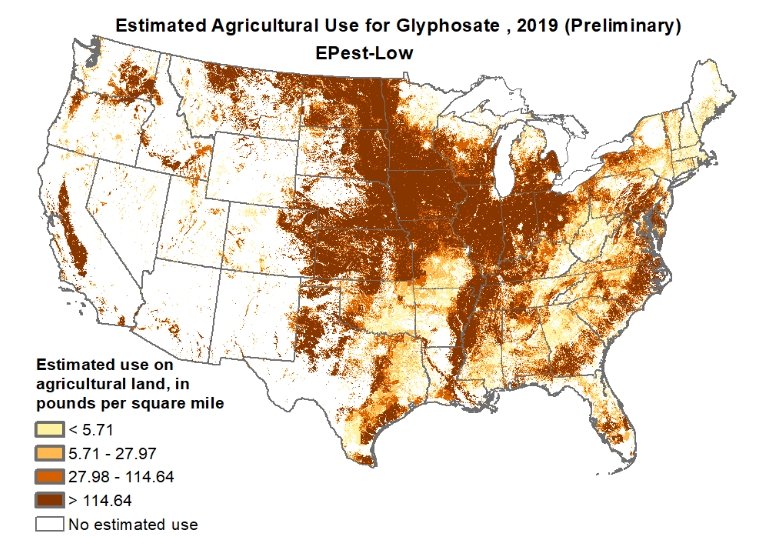
Glyphosate — a key ingredient used in agricultural pesticides such as Roundup — is the most widely used herbicide in the world. In 1974, Monsanto introduced the herbicide for agricultural use under the Roundup brand name; Roundup Ready soybean seeds were approved for use by the EPA ahead of the 1996 growing season after which use of glyphosate increased significantly. In Iowa, application rates skyrocketed at the turn of the century, and it is now the most-used pesticide in the state, with record amounts being applied in recent years. Iowa and Illinois consistently rank highest for states with the heaviest annual application of the chemical.
Figure 1: Glyphosate Application in 2019, USGS
In 2015, glyphosate was classified by the International Agency for Research on Cancer (IARC) as a probable human carcinogen. The IARC review of glyphosate found evidence of a link between glyphosate and non-Hodgkin lymphoma in humans. The review also found convincing evidence that glyphosate “can cause cancer in laboratory animals.” An interim review by the U.S. EPA in 2020, however, claimed no human health risks from glyphosate exposure and that it is “unlikely” to be a human carcinogen.
The EPA and IARC reached opposite conclusions about glyphosate safety primarily because they relied on different bodies of literature and emphasized different types of studies. Much of the federal regulatory risk assessment relied on a 2000 report conducted by three independent scientists and Monsanto employees, which was then cited repeatedly for decades. However, this study was recently retracted from the journal Regulatory Toxicology and Pharmacology. Journal editors cited serious concerns over validity, ambiguity, and misrepresentation. The article was also retracted for ethical violations regarding Monsanto's oversight of the article and self-serving regulatory recommendations.
Unfortunately, this retraction took place 25 years after its initial publication. When an article is published in a respected journal, such as Regulatory Toxicology and Pharmacology, it is assumed to have undergone rigorous peer-review and, subsequently, can be cited repeatedly in other journal articles, even across disciplines. The retracted study was cited 785 times. Over the past several decades, this misinformation has been used to inform other scientific research, guide policy decisions, create warning labels for consumer products, and advise the public and farmers about the safety of pesticides. Repeated citation and use of this now-retracted study no doubt contributed significantly to amplified use of glyphosate in Iowa. Iowa farmers have been using glyphosate for decades because agencies, including the EPA, relied on Monsanto’s ghostwriting.
Monsanto’s impact on the agricultural market cannot be understated. Bayer, a pharmaceutical and biotech company, acquired Monsanto in 2018 and has since worked to influence state and federal policy, far beyond fabricating scientific bias. Many Iowans are aware of what has been dubbed the “pesticide immunity bill” — a strategy from Bayer to limit lawsuits pertaining to the negative health outcomes incurred by people using its products. As of December 2025, Bayer has settled roughly 100,000 Roundup claims over the pesticide’s alleged cancer risk, with more than 60,000 lawsuits still active across the country. While pesticide immunity legislation passed in some states, such as Georgia, North Dakota, and Oklahoma, it did not advance through the Iowa legislature in 2024 or 2025, thanks to the grassroots efforts of everyday Iowans who shared their stories and continued to show up at the Iowa State Capitol in opposition.
Bayer representatives have made their presence known in the Iowa Capitol: meeting with the Governor, sending campaign donations to legislators, and regurgitating talking points from their own biased studies. Bayer spent more than $200,000 lobbying in Iowa in 2025 — more than any other year on record — often under the name “Modern Ag Alliance.” At the same time, Iowa grapples with our disturbing status as the state with the second-highest incidence of cancer and one of only two states where cancer is actually increasing.
The hypocrisy is too obvious: Bayer and its executives are reassuring the safety of their products, while simultaneously pushing policy to dodge lawsuits from customers who, as a result, are now cancer patients.
Bayer is also trying to limit its liability through an act of Congress. Tucked in a recent federal spending bill, Bayer helped legislators craft language that would have limited local requirements for pesticide warnings stronger than those already approved by the EPA, despite emerging research and the retracted article. Bayer’s effort failed due to waves of public pressure.
The Trump administration has urged the Supreme Court to take a ‘pesticide immunity’ case. Bayer is requesting the justices rule that individual states cannot require cancer warning labels, given that the EPA does not list glyphosate as a known human carcinogen. Therefore, Roundup consumers would not be able to sue for failure to warn. While Bayer failed in the federal appropriations bill, a ruling by the Supreme Court would flatline future lawsuits and leave farmers, landscaping workers, and others exposed to or injured by pesticides in the dark about health risks. The justices are expected to discuss the case this month, which could set precedent for multiple classes of pesticides.
Due to these interventions at the federal level, there is an urgent need for continued public action at the state level here in Iowa. The 2026 legislative session will again confront policymakers with Bayer’s deep-pocketed pesticide immunity push. Legislators need to hear testimony from their constituents about how pesticides like glyphosate and the misleading research by Monsanto have harmed them. Further, we need to listen to the farmers who have pioneered other alternatives by reducing chemical dependency, promoting regenerative agriculture, and healing our soil — rather than destroying the health of the land and the people who live on it.
Glyphosate is not the only pesticide that threatens public health, nor is it the only environmental risk factor contributing to Iowa’s high cancer rates. Look for our upcoming report, Environmental Risk Factors and Iowa’s Cancer Crisis, to be released in early 2026. Sign up for our email updates to stay in the loop.